What it is
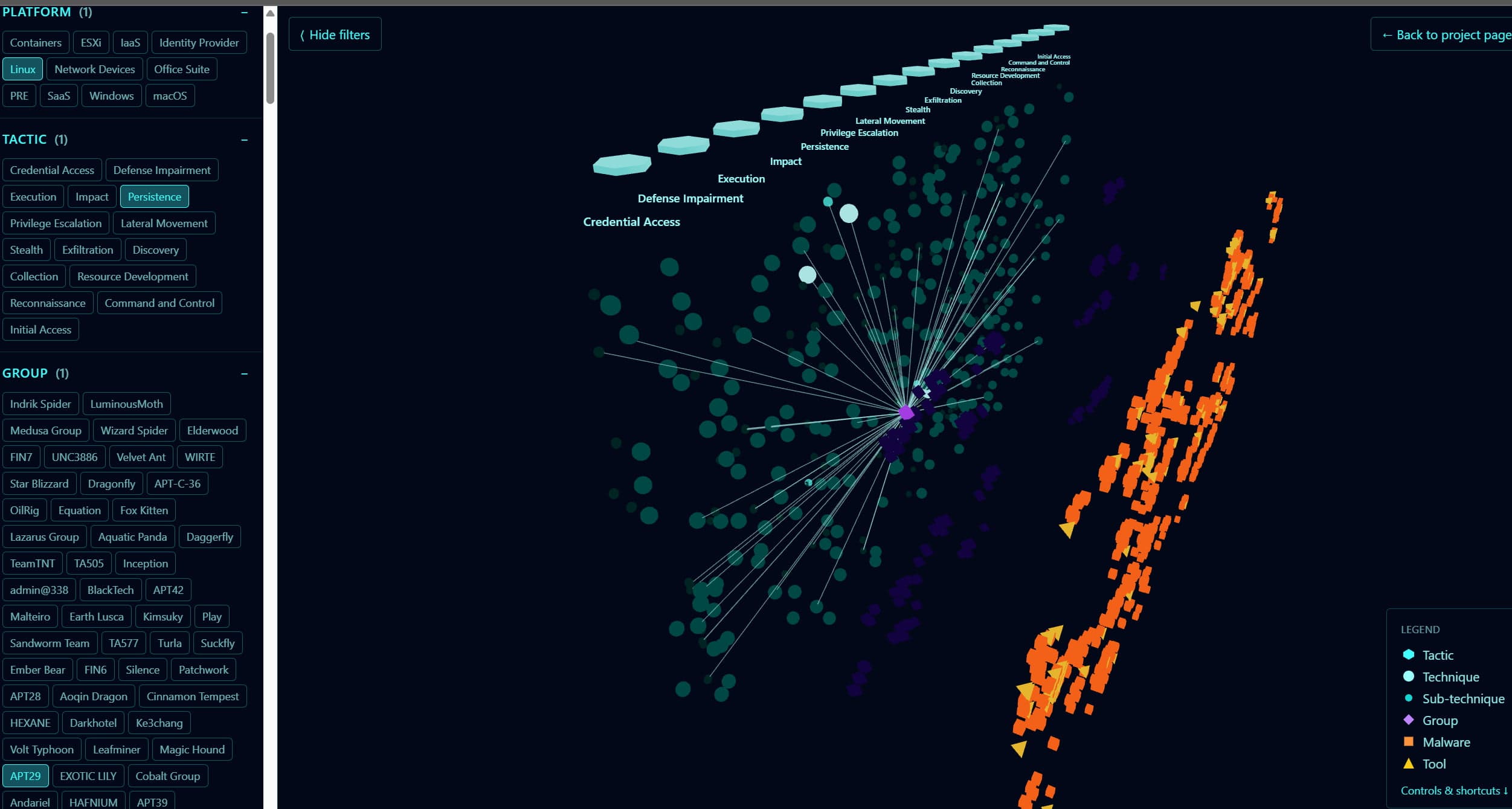
The ATT&CK matrix as most people know it is a 2D grid: tactics across the top, techniques in each column. It's useful but flat. The relationships between techniques, the threat groups that use them, and the malware that implements them all collapse into footnotes and external links.
This explorer treats the full corpus as a 3D graph: tactics arc across the top, technique clouds hang below each one, sub-techniques sit just behind their parents, and threat groups and software float in back-planes with translucent arcs to the techniques they touch. Search and multi-dimensional filtering make intersections obvious: “persistence techniques on Linux that APT29 has used and Lazarus hasn't” becomes a few clicks instead of a spreadsheet query.
How to use it
Open the explorer. Drag to orbit, scroll to zoom. Search by technique name or ID (T1059, PowerShell) or threat group (APT29,Cozy Bear). Stack filters in the left sidebar to find intersections. Click any node to inspect its full info and pivot to related nodes.
Data: MITRE ATT&CK Enterprise v17.1, auto-refreshed monthly via GitHub Actions.
Take something with you
The explorer itself runs on its own subdomain, so the useful thing to hand back from this page is a layer rather than a view. This one marks the ATT&CK Enterprise techniques that have an AI-specific analogue in MITRE ATLAS, shaded by how well established that analogue is: realized in the wild, demonstrated in research, or reasoned but unobserved. Load it into ATT&CK Navigator, or into the explorer, and the matrix lights up on the part of ATT&CK that AI systems actually change.